What Is Artificial Intelligence
What is artificial intelligence? Understand what AI is, how it differs from traditional software, and how machines learn patterns from data.
What Is AI, really?
Most people are already using AI. Almost nobody has actually explained what it is.
Not really. What you've seen are tools. Interfaces. Outputs. But not the thing itself not yet. To understand AI, you have to go deeper past apps, past models, past the surface to the smallest unit of logic that everything runs on.
The bit.
What a Computer Actually Is
A computer does not understand words, images, or meaning. Inside every device, there are no sentences. No pictures. No thoughts. There are only signals.
At the most basic level, everything is represented using two states: 0 and 1.
Off and On
No signal and Off Signal
These are called bits. That's it.
Everything you see messages, videos, even AI responses is built by arranging these tiny signals in structured ways.
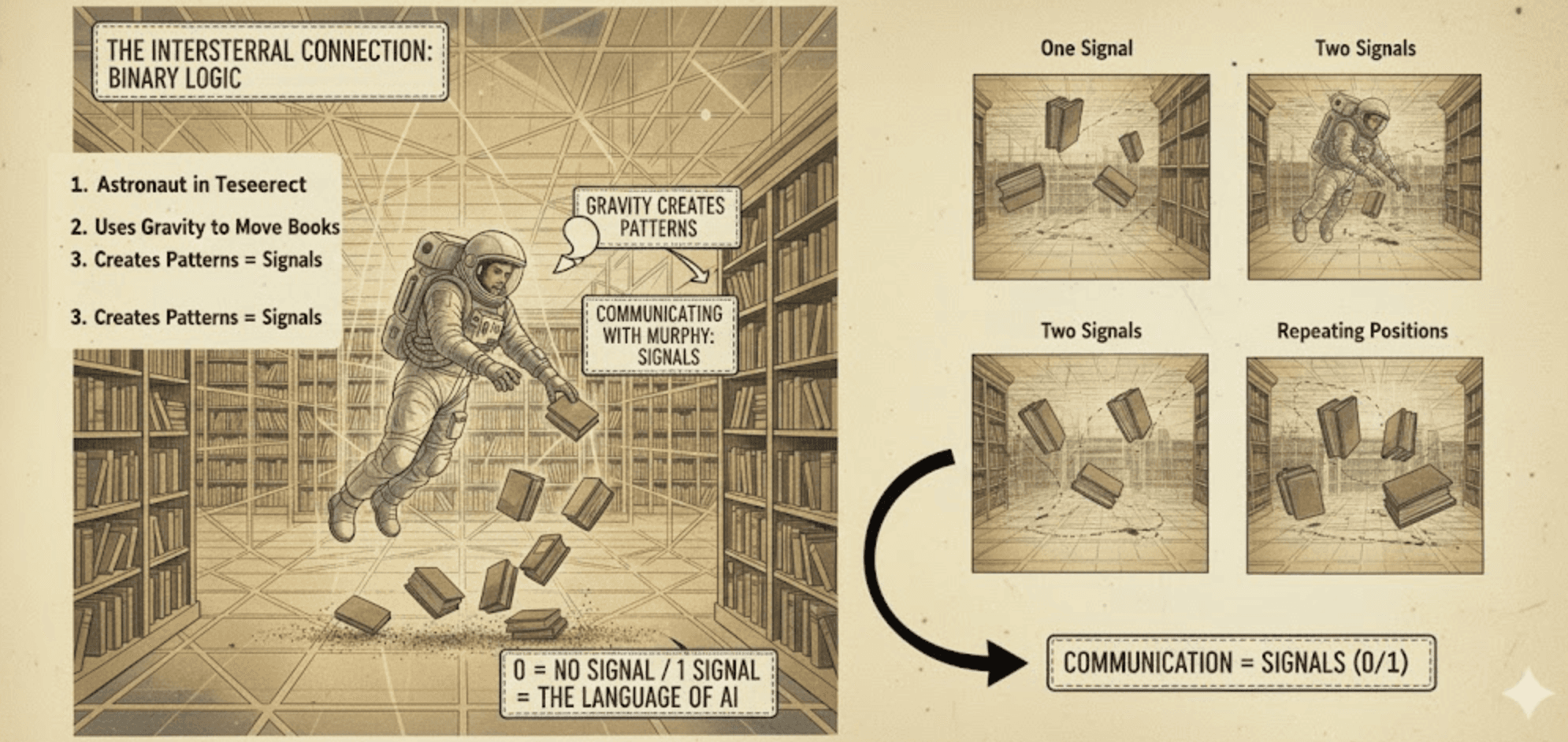
If you've watched Interstellar remember the moment Cooper is trapped beyond time and space, unable to speak or send words to his daughter?
He uses gravity to knock books off shelves. To move sand. To create patterns.
One knock. Two knocks. A pause. A sequence.
That's binary logic. Not language signals. Not meaning patterns.
Computers work exactly the same way. They don't understand your message. They receive a pattern of signals and process it.
AI is no different.
A Real Example: What Actually Happens When You Ask ChatGPT Something
You open ChatGPT and type: "Write me a follow-up email to a client who hasn't responded in a week."
It feels like ChatGPT understood your situation.
It didn't.
Here is what actually happened:
Your sentence was broken into small units called tokens fragments of words converted into numbers. Those numbers were passed through billions of mathematical rules shaped by patterns from an enormous amount of text. The system calculated which words were most likely to follow each other, given everything it had seen during training.
The result looked like a thoughtful email.
But the system never knew what a client is. Never understood what "not responding" feels like. Never considered your specific situation.
It matched patterns. The match was strong. So it felt intelligent.
This is not a criticism of the tool. It's the most important thing to understand about it.
From Signals to Something That Looks Like Intelligence
If computers only deal with 0s and 1s, how do they handle language, images, or decisions? They don't understand them. They process patterns. Every word, image, or input is converted into numbers. Those numbers move through layers of rules that transform them into outputs.
What you experience as "intelligence" is pattern processing not understanding.
The meaning is not inside the system. It's in how we interpret the output.
Those patterns represent signals: one signal, two signals, repeating positions. This is binary logic. Computers don’t understand language; they understand patterns of signals. AI is no different.
Where AI Becomes Different
All software follows rules.
Traditional software follows fixed rules written by humans.
For example:
If you enter the wrong password → show error
If balance is below zero → block transaction
Every situation is handled through predefined instructions.
AI systems work differently.
Instead of being told exactly what to do in every case, they are shown examples and learn patterns from them.
Rather than: "If X happens, do Y"
AI works more like: "When I've seen patterns like this before, the outcome was usually this"
This allows AI to handle situations that were never explicitly programmed.
But the trade-off is important:
Traditional software is predictable because rules are fixed. AI is flexible because behavior is shaped by data.
And in both cases,
there is still no understanding. Only rule execution in different forms.
Why It Feels Like AI Understands
When AI gives a good answer, it feels like reasoning. When it writes clearly, it feels like understanding.
But what's actually happening is simpler.
The system is finding the most likely output based on patterns it has learned.
It's not thinking. It's matching.
And when the match is strong,
it feels intelligent.
What You Should Take from This
AI is not a mind.
It is a system that:
Takes input
Processes patterns
Produces output
Nothing more. And nothing less.
Where This Leads Next
The bit is just the beginning.
What happens when you connect billions of them together
is where things get interesting.
What are these rules? How do patterns get formed? What is the system actually doing internally?
That's where we go next.
→ Next: NAND to Intelligence — How Simple Rules Create Complex Behavior
KEY TAKEAWAY
Before you move on, pause with the central idea from this lesson and connect it to the next step in your learning path.


