NAND to Intelligence: How Simple Logic Gates Power Artificial Intelligence
How does NAND connect to AI? Explore how simple logic gates build computation, processors, and the foundations of modern artificial intelligence.

1.NAND to Intelligence: How Simple Logic Gates Power Artificial Intelligence
Artificial Intelligence often feels mysterious. When an AI writes text, recommends content, or predicts outcomes, it can feel like a digital mind is thinking inside our devices.
That impression is wrong.
AI does not think, intend, or understand. Every AI system runs on physical hardware and follows simple rules. The most important of these rules comes from a tiny computational building block called the NAND gate.
Understanding NAND gates explains what AI really is and removes fear, hype, and blind trust. This is the foundation of real AI literacy.
2.Computation Is Physical
AI is not abstract. It exists as electricity moving through silicon.
Inside every computer chip are billions of microscopic switches called transistors. Each switch is either ON or OFF. These states are represented as 1s and 0s, called bits.
At this level, computers do not recognise words, images, or meaning. They respond only to voltage. Every calculation, instruction, and AI output is produced by controlling how electricity flows.
Key idea:
AI is a physical system executing rules, not a digital mind.
3.What a NAND Gate Is ?
A NAND gate is one of the simplest rules used to control electrical signals.
It follows one condition:
If both inputs are ON, the output turns OFF
Otherwise, the output remains ON
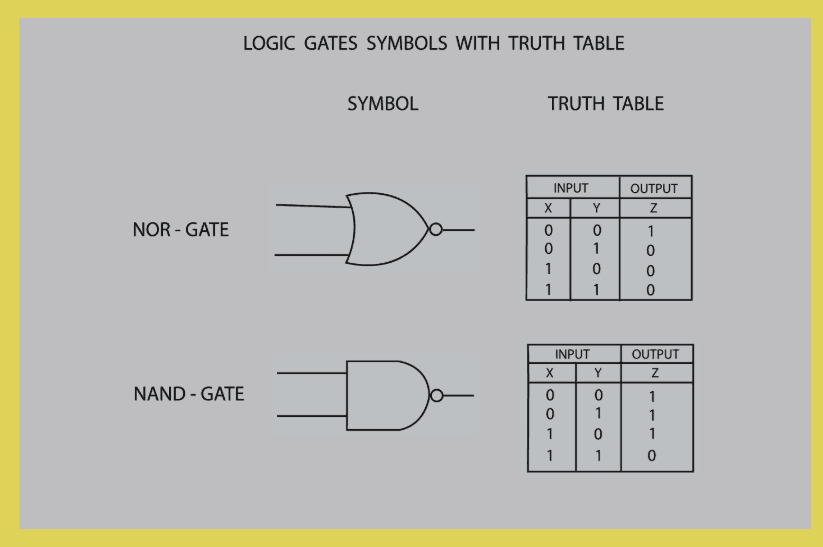
A NAND gate has no memory and no awareness. It reacts instantly to its inputs.
On its own, it does nothing impressive. In large numbers, it enables everything.
4.Why NAND Is Fundamental
NAND gates are functionally complete, meaning they can recreate all other logic.
Here is the simplest proof.
A NOT gate flips a signal:
ON becomes OFF
OFF becomes ON
If you feed the same input into both sides of a NAND gate, the output flips. A single NAND gate becomes a NOT gate.
By combining NAND gates, engineers can build:
NOT gates
AND gates
OR gates
5.From these, any logical system can be constructed.
Key idea:
NAND is powerful not because it is complex, but because it can become anything.
From Gates to Computation
When NAND gates are connected together, they form logic circuits. These circuits allow systems to follow rules such as:
If this condition is true, do this
Otherwise, do something else
As these circuits scale, they enable computation — the execution of structured instructions.
Every program is a flow of logical decisions resolved by NAND-based circuits switching at high speed.
Key idea:
Computation is rule execution at scale, not intelligence.
6.The Hierarchy from NAND to AI
AI does not appear suddenly. It emerges through layers:
NAND gates
→ Mathematics
→ Programs
→ Models
→ AI systems
Each layer depends entirely on the one below it. Nothing magical happens at the top.
AI does not replace logic.
It is logic layered, scaled, and optimised.
7.Where AI Begins: Models
Traditional software follows fixed instructions. AI begins when instructions become adjustable.
AI models contain numerical parameters that influence outputs. These parameters are updated through computation based on error.
Every update is still executed through NAND-based logic.
Key idea:
AI rearranges rules it does not escape them.
8.How Learning Works
AI “learning” is mechanical.
The system:
Makes a prediction
Measures error
Adjusts internal values
Repeats
Over time, some outputs become more likely.
Learning is structural change, not understanding.
9.A Useful Mental Model: Hills and Valleys
All the NAND gates, logic circuits, and learning rules described so far shape a mathematical landscape inside the system.
When an AI processes an input, it is not choosing or reasoning. It is more like a ball dropped onto this landscape. The ball rolls downhill until it settles into a valley the most stable outcome given the rules and data.
Learning reshapes the terrain. Useful outputs deepen valleys. Poor outputs flatten them. Over time, the system becomes more likely to settle into certain results.
This explains why AI can sound confident without understanding, and why it can repeat the same mistakes consistently. The system isn’t thinking — it’s settling.
10.Why AI Feels Intelligent
At large scale, AI outputs align well with human expectations. This alignment feels like intelligence.)
Internally, nothing has changed. The system is still executing simple rules. Complexity emerges from scale, not awareness.
Key idea:
AI feels intelligent because behavior emerges, not because understanding exists.
11.How This Affects Daily Life
NAND-based AI systems shape navigation, recommendations, fraud detection, and automation.
They reduce mental effort by predicting outcomes and suggesting actions.
When AI fails, the cause is usually biased data or poorly chosen goals — not intent.
Understanding this helps you use AI without surrendering judgment.
The Real Risk
Simple rules are not dangerous. Scale is.
When systems optimise narrow goals at massive scale, small design choices can affect millions of people.
The risk is not intelligence.
The risk is unchecked optimisation.
From NAND to Responsibility
AI is not conscious.
AI does not choose goals.
AI does not understand consequences.
Humans design systems, choose data, and define objectives. True AI literacy means knowing where responsibility lies.
Understanding NAND is not about electronics.
It is about accountability.
You now understand the foundation the single rule that everything builds on. But rules alone don't explain how a machine goes from switching electricity on and off to recognizing your face or writing a sentence. That leap happens through computation.
KEY TAKEAWAY
Before you move on, pause with the central idea from this lesson and connect it to the next step in your learning path.


