How AI Learns From Data: A Simple Non-Technical Guide
How does AI learn from data? Understand training, patterns, model parameters, and how examples help AI systems produce useful predictions.

How AI Learns From Data: Learning, Memory, and Neural Networks Explained Simply
Imagine a self-driving car approaching a stop sign in a blizzard. It doesn’t “know” what a stop sign is because it went to driving school; it knows because it was shown millions of blurry, snowy images until it stopped making mistakes.
When people hear that AI learns from data, it sounds like sci-fi. Does it study? Does it understand? The short answer is no but what it does instead is even more fascinating. To really understand how AI functions, we need to look at four simple ideas: learning, memory, computation, and neural networks.
1. Learning: Adjustment, Not Understanding
In humans, learning is about meaning. In AI, learning is about adjustment.
When an AI “learns,” there is no “aha!” moment. Instead, the system slightly adjusts its internal settings so that next time, it provides a better output.
Micro-example: Think of a spam filter; every time you click “Not Spam,” you aren’t teaching the AI a rule, you are physically nudging a digital dial so that specific word patterns are less likely to be blocked tomorrow.
The goal is simple: reduce error through repetition at scale.
2. Memory: The “Valley” Concept
AI memory is structural, not emotional. Think of it like a landscape where information is stored as stable states imagine a ball resting in a valley.
Micro-example: If an AI “remembers” your face, it hasn’t stored a photograph; it has shaped a “valley” in its digital landscape that only the specific geometry of your features can roll into.
As long as that valley exists, the ball stays there. AI memory isn’t a story; it’s a collection of these “stable valleys” that the system can revisit to find the right answer.
3. Computation: Data Transformation
At its core, computation is simply transforming information from one form into another. Whether it’s a calculator or a GPT model, the process is:
Input → Transformation → Output.
AI doesn’t reason or question these rules. It simply applies learned transformations at lightning speed, which is why it can feel intelligent without ever understanding what it produces.
4. Neural Networks: The Engine of Patterns
“Neural Network” sounds intimidating, but think of it as a multi-layered filter system.
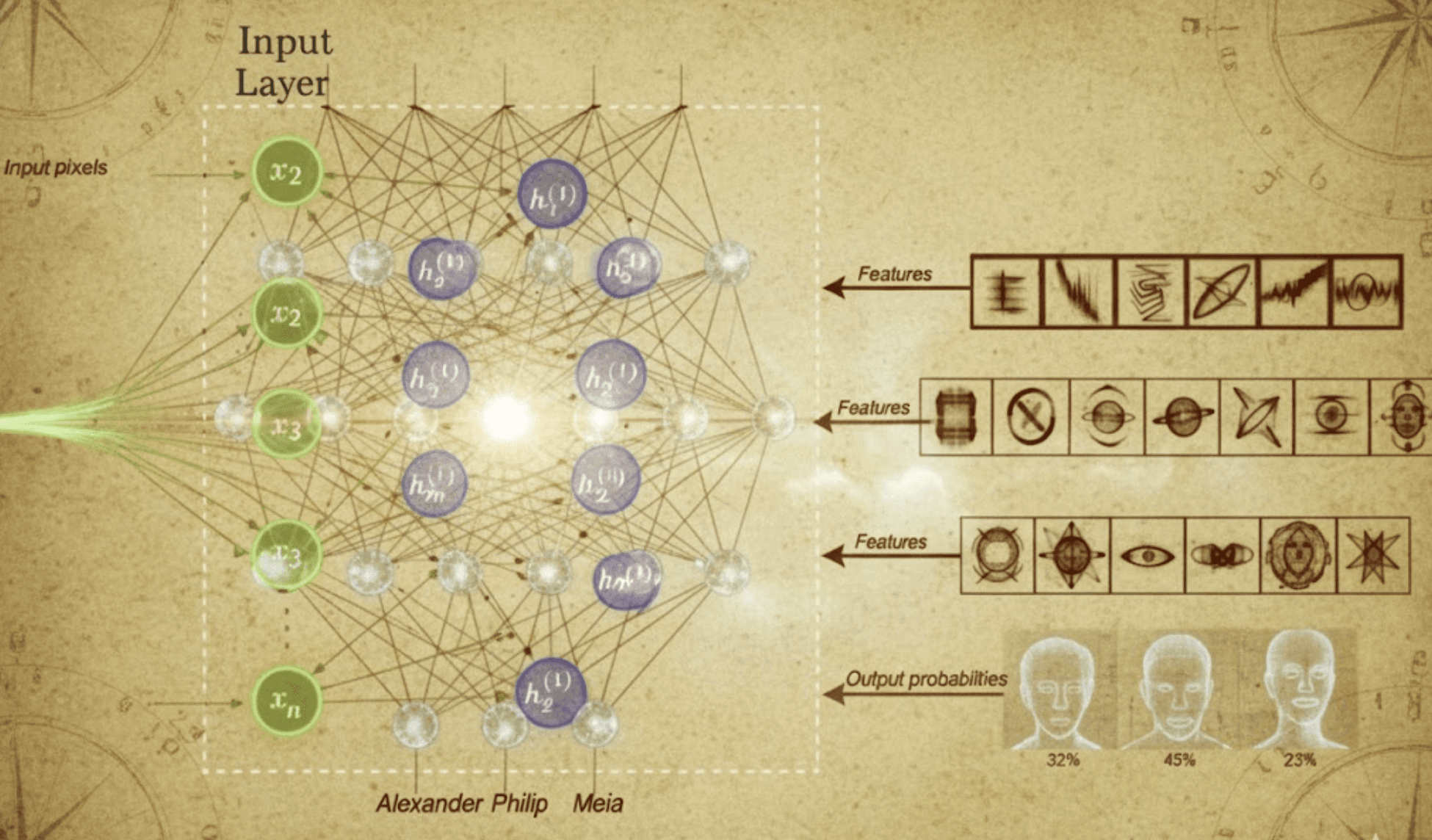
(A neural network diagram showing how raw pixels are transformed through hidden layers into high-level features to identify a face.)
At their core, these networks combine numbers, weigh their importance, and pass results forward. Early layers notice simple patterns, while later layers combine them into complex ones. (For a broader foundation, you may want to read what artificial intelligence really is.)
Micro-example: This is why an AI can recognize a cat from millions of images without ever knowing what a cat actually is.
Why Data is the Real Teacher
AI doesn’t learn from instructions; it learns from exposure. Data shapes the AI in three critical ways:
It Shapes the Landscape: Good data creates reliable paths; bad data creates misleading shortcuts.
It Defines “Correct”: AI has no moral compass. Data tells it what outcomes are rewarded.
It Sets the Limits: AI cannot learn what isn’t there. If the data is biased or incomplete, the AI will be too.
This is why a recommendation algorithm can accidentally amplify anxiety, or a hiring system can quietly repeat past bias not because it wants to, but because the data shaped the valleys that way.
The Core Insight: Patterns Over Intelligence
AI learning is not “intelligence emerging.” It is patterns stabilizing. Given enough data, useful paths deepen and bad paths fade. AI doesn’t think ahead or reflect—it simply settles into the most efficient pattern, like a ball rolling into the nearest valley.
When AI fails, it doesn’t fail for one person—it fails for everyone shaped by the same data.
Final Thought
AI learns like nature: slowly, mechanically, and without awareness. This allows us to trust AI where it is strong (finding patterns) but question it where it is weak (meaning and ethics).
You now understand how AI learns by reshaping its landscape through experience until the right answers become the deepest valleys. But where is this actually happening in your life right now without you even noticing?
KEY TAKEAWAY
Before you move on, pause with the central idea from this lesson and connect it to the next step in your learning path.


